Sunday, July 16, 2017

The Wonder Preah Vihea Temple


Preah Vihea is a great of art and architecture, a cultural jewel with a triumph of history spanning millennia, and then this wonder temple was registered as a World Heritage site by Unesco on July 7, 2008 in Quebec, Canada. Preah Vihear temple is an masterpiece of Khmer creative genius, a unique testimony to a cultural tradition or civilization, an outstanding architectural or technological ensemble, or a landscape illustrating a significant stage in human history. 


About ten ancient Kings were involved in the construction, but most work was done by only six of them. The temple was begun by King Yasovarman I (889-910 AD) who build to the foundations and the east-ern stairs which rise nearly a kilometer from the forested plains. King Suryavarman I, (1002-1050) and his son King Udayadityavarman II (1050-1068) carried on, laying out most of the monolithic features present today. King Jayavarman VI (1080-1107), King Dharanindravarman I (1107-1112), and King Suryavarman II (1113-1150) added the finishing touches. The Preah Vihear temple was dedicated to Shiva, a God of the Brahman religions, but it was not cut off from Buddhism because most of the Kings who helped to build this temple understood Buddhism. 

The temple's layout is complex. It has four levels with four courtyards, each containing five Gopuras (entrance pavilions). Since the ancient time till now, Preah Vihear became a place of pilgrimage and sacred worship for kings and commoners alike, as it is a styli shed representation of Mount Meru, home of the Hindu gods.


Interested? Please reach us @ http://trailtoangkortours.com/contact-us.html, we will respond your shortly 

See you around!


TRAILTOAngkortours and Travel - Kingdom of Angkor

Wednesday, July 5, 2017

Siem Reap and Countryside Activities 

Part I: Farming (Rice Growing & Its Process)

Talking about Siem Reap tour, people usually think of temples tour or any other sacred places to visit, but they might forget that there is countryside and there are many rice paddies fields located around the corner of the town. Besides providing beautiful scenery, rice fields is the main source to produce rice which is the most popular and important food for Khmer people. 80 percent of total population is farmer and some of them still prefer cultivate rice crop in traditional ways while some turn to do it by using machines. Growing rice needs to spend labor, time, and money, so it is possible to say that it is not an easy thing to do before we have rice as the final product to eat.

Based on the weather and Calendar of Cambodia, rice is mainly produced in Raining season (from May to October) since there will have enough water supply to support rice farming. However, this practice can also be done during Dry season (from November to April) if there has enough sources of water. For example, the rice fields are located near river or lake or the irrigation systems. The question is that how many steps in order to do rice farming? The brief description below are the stages of doing rice farming.

Angkor Wat temple
Rice field at Bakong Village, Siem Reap


Land Preparation

Farmers usually plow their fields when the soil is wet by using Khmer traditional plow as the tool pulling by two oxen or buffaloes as the power. The soil is plowed to a depth of 70 – 100 mm. Depending on the condition of the soil, it will need to be plowed again from 3 – 6 weeks after the first time of doing it.

Since the development of economy and technology, some of Cambodian farmers turn to use machines like plowing machine to save their time and energy and it provides a good result as well.

Khmer traditional plow pulling by oxen

Khmer traditional plow pulling by buffaloes


Plowing machine

Planting


After plowing and leaving it to get into good condition, it is time to plant the rice crops and there are two methods to do so. Farmers can choose to plant their rice crops by either transplanting them from a nursery, which usually takes up 15-20% of the farming area, or broadcasting (scattering over a wide area). They both can be practiced based on location and rice ecosystem in the region they are doing farming.

Transplanting is more common among the two methods because broadcasting can only be done in the rain-fed lowland areas of the country, and it generally gives a lower output than transplanting.

Transplanting, however, is very labor intensive, requiring between 30-40 person-days to establish 1 hectare of rice. If a family does not have enough members to do this work, they will look for exchanging labor. It is Khmer culture from the past that if one family does not have enough labor to do their rice planting, they will exchange labor with their neighbor which means this time, the members from other families come to help them and when it becomes their neighbor turn, they will take turn and revert to help them back. Or, if the family’s economy is good, they can hire labor in the area to help them as well.


Farmers are transplanting rice plant


Transplanted rice plant


Period of taking care the plants

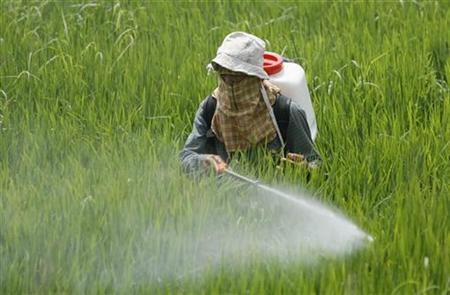
It is the stage that farmers need to take care of their rice planting. During the period that their plants are growing, they will need to weed their fields and use some chemicals to control the weeds. Besides this, they have to use pesticide to control the pests or other insects that damage their crops.

Farmer is weeding the rice field

Farmer is spraying chemical pesticide to control pest

Fertilization is an important stage in rice farming. Besides using animal manure, most farmers use chemical fertilizers for their nurseries and their fields. All fertilizers are applied manually. Farmyard manure is transported by animal-drawn carts during the dry season and placed in strategic piles in the fields. Spreading is done by water movement and during land preparation. Inorganic fertilizers are hand-spread and, where necessary, incorporated by harrowing. 

Organic fertilizer made from animal manure

Inorganic/chemical fertilizer


Water is the most important thing that helps crop growing well. To get this, irrigation system needs to be built in order to supply water to the fields besides nearby rivers or lakes. Some rice-growing areas in Cambodia are irrigated to water supply during the dry season to enable farmers to plant rice two or three times per year. The use of irrigation systems has been increasing in these recent years. However, many farmers will still need to pay to pump water into their farm area, as there may be some distance from the main water channels.

Irrigation system (canal)

Irrigation system (pump water)

Harvesting

After the long period and having many works to do from land preparation stage until period of taking care, it is the time to collect the yields from planted rice. Crops are manually harvested and tied into sheaves. These sheaves are placed on top of the standing stubble or transported to a central threshing site where they are dried for 2-3 days. Depending on locality, threshing is done at a central site in the field or in the village.

Harvesting rice crop by using traditional way (curve knife)

Harvesting rice crop by using machine


crops tried into sheave
A small number of farmers own mechanized cutting or gathering machines, but this is rare due to the high cost of such a machine. Grain is removed from the panicle in a number of ways. For example, Sheaths are laid on the roadway so that they are run over by passing vehicles or hand-threshing is done using a board against which the stools are hit. 

After getting grain, it is time for taking them to be milled in order to get rice as the final product of rice farming. It can be done with Khmer traditional ways or machine.

Rice hand-threshing 

Rice grain after threshing


Rice milling with Khmer traditional tool

Rice milling with machine

Rice grain
Milled rice


TRIP MESSAGE: The activities and spectacular view of countryside in this blog article is available in Siem Reap, kingdom of Cambodia and this interesting scenery is brought to you by TRAILTOAngkortours and Travel. 

Our company is the local tour operator based in Siem Reap, Cambodia established by Khmer local people. With the team that have experience in this tourism industry for more than 12 years, we put all our efforts and commitments to arrange and provide all our value customers an unforgettable trip. Customer services and flexibility are our top principles to work in this business. 

“Satisfaction and enjoyment of our customers are also ours, so we will serve them in the level best from our heart and passion”, President of TRAILTOAngkortours and Travel.  

Interested in our packages? Reach us @www.trailtoangkortours.comOur team will respond to you shortly.

Stay tuned for part II of Siem Reap and Activities blog article! 


Steven Lor, Sales Manager - TRAILTOAngkortours and Travel  


Saturday, June 24, 2017

Kingdom of Wonder (Cambodia) Kingdom of Million Elephants (Laos)

Cambodia and Laos are known as the countries that have a long history in Southeast Asia. They share the same religion and similar culture in some ways. Being known as the former parts of Indochina countries during the French colonial, these two countries have become the interesting tourist sites of the region and the world in this modern era. Therefore, are there any attractive places which are worth to visit while staying in each countries?  


Let’s start from Cambodia. Cambodia is considered as one of the popular tourist sites and it is called Kingdom of Wonder, based on the plenty of cultures and the fabulous temples located all over the country. Tourists can plan their trip to Cambodia by thinking of visiting the gorgeous temples in Angkor area as well as the highlighted temples of Angkor. What’s more, they should not miss the chance to see the remote temples which are located far away from the town and Angkor area.


Besides Angkor area, there also have villages in the countryside surrounding the town that tourists are able to get another unique experience by exploring the daily life of Khmer people living there and seeing the differences between life in countryside and town. Visiting the countryside, they will have an opportunity to join and learn how to do farming with local farming family as well. By leaving from the land of cultures, our tourists can extend their destinations to visit Phnom Penh, the modern capital city of Cambodia and continue to have beach break at the Southwest part of the country.


Getting back to Laos. Laos is one of the three countries that share the border with Cambodia besides Thailand and Vietnam, and it is also called the Kingdom of Million Elephants, the land that has abundant of elephants living. This country also have many interesting places to see such as temples, natural water fall, and rivers, so on and so forth; the tourists can reach these sites by visiting some provinces and city of Laos – Luang Prabang, Vientiane, and Pakse.


They will have chance to see the building built to dedicate for religion such as Wat Sisaket, Wat Prakeo, and Wat Xiengthong. Also, they are able to visit Pak Ou Cave, Kuangsi waterfall, National Museum, the plain of jars, and so on. Our tourist can travel from Laos to Cambodia back and forth easily due to the fact that these two countries have a good relationship with each other so that tourists can reach each countries by land (crossing the border) or flight, so this can be known as the gateway to Laos and Cambodia for those who would like to have trip for Cambodia and Laos tour


TRIP MESSAGE: Tour to Cambodia and Laos Packages are brought to you by TRAILTOAngkortours and Travel. Our company is the local tour operator based in Siem Reap, Cambodia established by Khmer local people. With the team that have experience in this tourism industry for more than 12 years, we put all our efforts and commitments to arrange and provide all our value customers an unforgettable trip. Customer services and flexibility are our top principles to work in this business. “Satisfaction and enjoyment of our customers are also ours, so we will serve them in the level best from our heart and passion”, President of TRAILTOAngkortours and Travel.  

Interested in our packages? Reach us @ www.trailtoangkortours.com. Our team will respond to you shortly.

See you in Cambodia! 
Steven Lor, Sales Manager - TRAILTOAngkortours and Travel  
   

Thursday, June 15, 2017

Khmer Circus, one of the best things to see in Cambodia

We all may know already about circus show or circus performance from Western culture that we learn it from books or the show on television. On the other hand, Khmer circus performance is a kind of art that has existed in Cambodian culture for centuries. There are some evidences of this art on some temples in Cambodia, especially the carving of circus performance on Bayon temple which is well shown that Khmer circus already appeared since Angkor period, which was last around 600 years.


The carving depicts the different forms of circus performance such as acrobats, contortionists, magicians, jugglers, dancers, clowns, and even animals such as snakes and monkeys. After having war for years, the circus performance was dropped off for a while and it started to be resumed when the country got peace and independence during the Songkumreasniyum era led by the late king, his majesty Norodom Sihanouk. Then, this activity was abandoned once again during the Khmer Rouge regime as it did not happen only on Khmer circus but also other forms of Khmer arts. 


After the fall of Khmer rouge, everything was reborn and so was Khmer circus. In the meantime, there is an organization, called Phare Ponleu Selpak, that help children who suffered from poverty, abuse, and hurt by giving them social support, education, and art classes. Currently, tourists are able to see Phare, the Cambodian Circus show both in Siem Reap and Battambang province and this activity has become the popular thing to do that is highly recommended in Cambodia tour or itineraries for visiting Cambodia


This circus performance not only helps to earn fund to support the children in the organization but it also helps to preserve this kind of Khmer art. 

Interested in this activity? Reach us @ www.trailtoangkortours.com and our team will respond to you shortly.

See you in Cambodia! `


Tuesday, June 13, 2017

Calendar of Event in Cambodia

CAMBODIA INTERNATIONAL FILM FESTIVAL
March 4-9
Six consecutive days celebrating the work of filmmakers sees thousands of locals, especially youngsters, as well as many foreigners gather in Phnom Penh theaters. The program highlights movie made in or about Cambodia, but there is also a selection of films sourced from around the world. These come in a variety of formats, such as short and long fictions, documentaries, and animation. Screenings Major Cineplex, the French Institute and Bophana Center, as well as at an outdoor venue on Diamond Island (Koh Pich)


SIHANOUKVILLE HALF MARATHON 
March 5
This running race around one of the “Most Beautiful Bays in the World” was founded in 2012, with the purpose of promoting environmental conservation and supporting local charity work. Funds raised go towards the activities of the Cambodia Red Cross, as well as NGO projects for the victims of natural disasters, the education of disadvantaged children in Sihanoukville, and training program for lifeguards along the beach. Organizers welcome all runners from across the world to participate in the sixth edition of the half marathon (21kilometres) this year, or attend as spectators.


INTERNATIONAL WOMEN’S DAY 
March 8 
International Women’s Day is an official holiday in Cambodia. Around the country, people will honor their mothers, wives, girlfriends, colleagues and such, with flowers and small gifts. The international theme this year is #BeBoldforchange, with organizations and individuals showing their commitment to the campaign to help women and girls achieve their ambitions, challenge conscious and unconscious bias, call for gender-balanced leadership, value women and men’s contributions equally, and create inclusive flexible cultures.


RIVER FESTIVAL 
March 24-26 
Following on from successful editions held in Kratie in 2015 and Kampong Cham last year, the northern province of Stung Treng is to host the 2017 River Festival. Organized by the Ministry of Tourism under a campaign slogan of “Clean City, Clean Resort, Good Service, Best Hospitality”, the event aims to educating the general public in the helping to protect the environment and maintain public sanitation, especially along the rivers such as the Mekong, which runs through Stung Treng province. This helps ensure the area remains attractive for local and foreign tourists for years to come.


ANGKOR SANKRAN FESTIVAL 
April 14-16
This huge, open-air event, held inside the Angkor temple complex and at select locations across Siem Reap town, is marking its fifth edition this year. It features three full days of programs coinciding with the three official days of Khmer New Year on April 14-16. The free festival aims to educate young Cambodians and foreign visitors in the carious customs and traditions of the Kingdom, as well as entertaining them with classic Khmer art forms and fun group games, and keeping them nicely stuffed with a multitude of locally-produced treats.


KHMER NEW YEAR 
APRIL 14-16
Cambodia New Year – or Choul Chhnam Thmey in the Khmer language, literally “Enter New Year”- is the name of the Cambodia  holiday that celebrates the New Year. The holidays lasts for three days beginning on New Year’s Day, which usually falls on April 13th or 14th , marking the end of harvesting season, when farmers enjoy the fruits of their labour before the rainy season begins. Cambodians also use the Buddhist Era to count the year based on the Buddhist calendar, it is 2560 BE.


Interested? Please reach us @ http://trailtoangkortours.com/contact-us.html, we will respond your shortly 


See you around!